

Yolanda Martín
For me, teaching has always been something vocational, so since I started my studies in Translation and Interpreting in the Universidad Autónoma in Madrid (French and English), I also began to teach Spanish and French.
It was that vocational spirit, my love for languages and the wish to be in contact with people from other places and cultures that made me take the decision of dedicating myself to teaching exclusively, after 7 years working as a translator and editor.
Initially, I gave face-to-face Spanish lessons in different international companies in Madrid, but when I moved to Tenerife I started to give classes using videoconferences.
In the recent years, I have focused on trying to better understand my students' needs, on how to adapt myself to their different learning styles and on how to deal with difficulties that prevent them from progressing with the aim of providing a more effective Spanish learning.

Zaida González
I hold a degree in Spanish Language and Literature and a Master’s degree in Linguistics and Spanish as a Foreign Language, giving me a solid background in teaching Spanish. From a very young age, I have been passionate about languages and grammar, especially Spanish and English, which is why I decided to dedicate myself to teaching.
Throughout my career, I have had the opportunity to work with students of different ages, nationalities and needs, which has allowed me to develop an open and flexible vision of education, as I believe that each student is unique and that learning is more effective when it is adapted to their individual needs, interests and goals.
I define myself as a warm, empathetic and very patient person. I enjoy guiding my students through their learning process, creating a trusting atmosphere where they feel confortable participating, making mistakes and, above all, communicating.
My main objective as a teacher is to help my students develop their language skills while enjoying the learning process and discovering the richness of the Spanish language and culture.
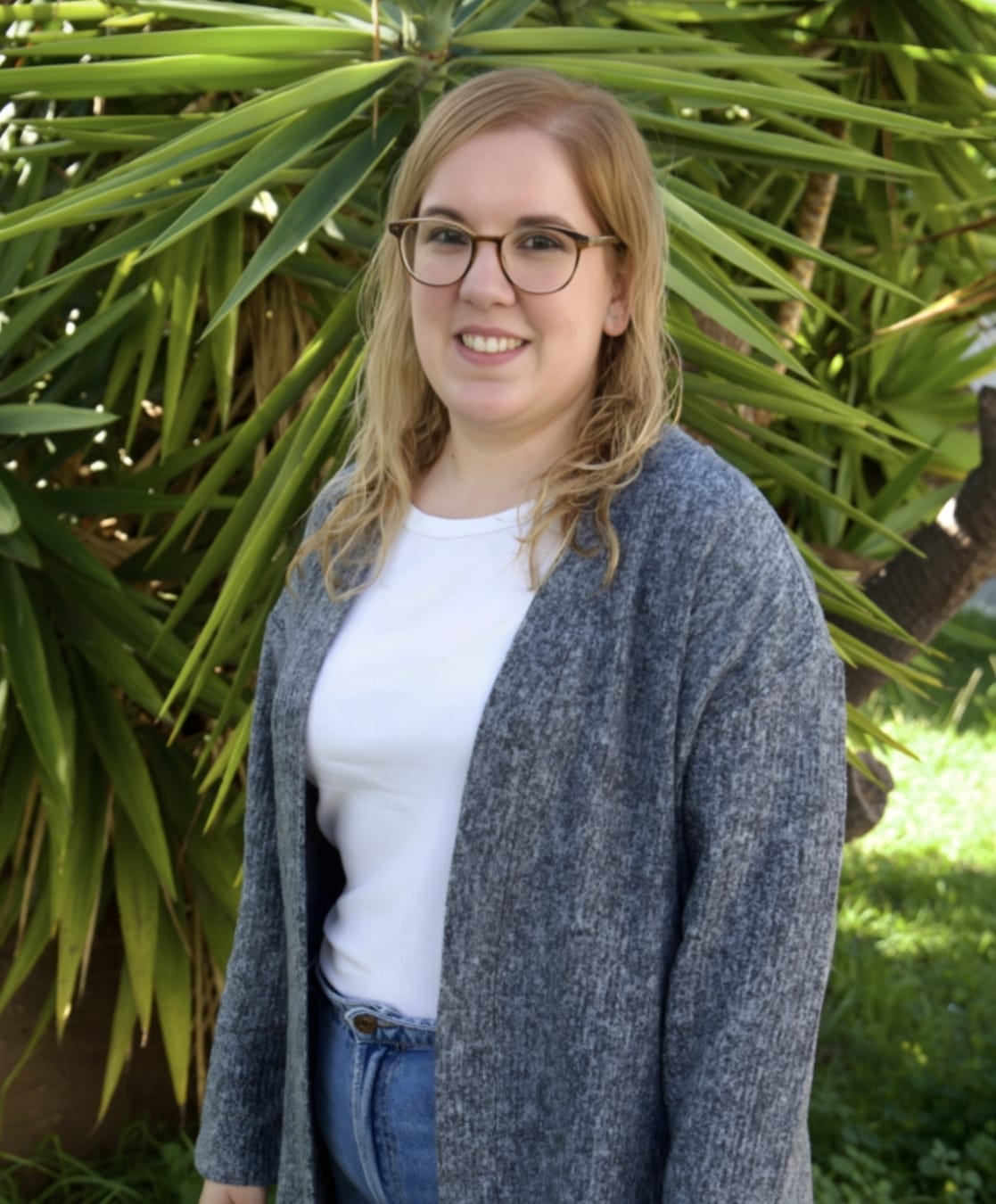
Maribel Jiménez
My name is Maribel and I am from a small town called Talavera de la Reina, in the center of Spain. I would describe myself as a dynamic, open-minded and a curious person. I have spent more than 10 years learning languages, I speak Italian, French and English.
As I travelled around the world I realized that it is essential for language students to practice speaking the language they are studying, so I like to focus on conversation skills in my classes using vocabulary and common expressions that Spanish people use in everyday life.
Barriers can be broken and fear of making mistakes while speaking can be lost, one of the biggest blocks we face when trying to speak another language. I will help you to do it.

Teaching method
– We apply a communicative approach in the classes. Grammar aspects are explained and put afterwards into practice with the student. We try that the student practises what he/she has learned, mainly orally, so lessons are very interactive: the student is the main character.
–Personalized classes. All students are different and have their particular way of learning. We focus on their learning goals, working on their difficulties and reinforcing their strengths. Moreover, we will keep in mind their interests, personality, learning speed, etc.
–Adapted material. In the sessions, we use Google Drive to be able to prepare student-designed lessons. We use plenty of resources (books, material from Internet, graphics, audios and videos, etc.) which are adapted to the student. Apart from that, we send self-prepared homework to put more into practice what has been learned in the classes.
-Exercises in Social Networks. To motivate students with their progress in learning the language, in Your Spanish Classroom we have created Facebook and WhatsApp groups where you can practice with other people who are in the same situation. There you will have playful and cultural exercises with individual corrections.
-We aim to communicate with the student in a common language (English/French) during the first sessions. After that, the communication will take place in Spanish, adapting to the student’s level in this language, although we may still use the student’s mother tongue (or reference language) to compare it with Spanish and thus make him/her unterstand some concepts better.